
How we check
Every check is done by AI, from start to end. Here is what happens, what the verdicts mean, and where it can go wrong. Actually is made by Factual Logic.
Last updated: 17 November 2026
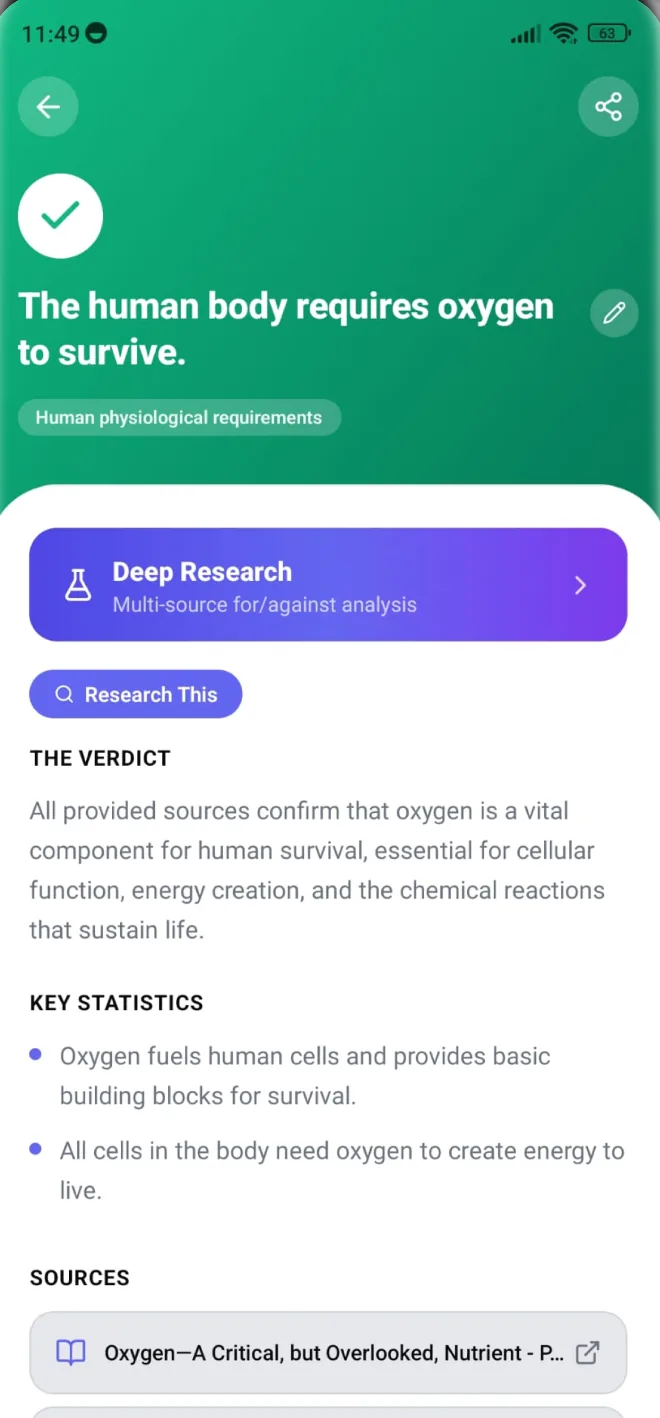
What happens when you check a claim
Picking out the claims
An AI language model reads your text (in Live, a transcript of what was said) and lists the statements that can be true or false: numbers, dates, events, records. In a typed or pasted check, opinions, questions, jokes and slogans are left out. Each claim has to stay close to your own words. Email addresses, phone numbers and card numbers are removed before the text reaches the AI.
Searching the web
For each claim, Actually runs a web search with the claim itself and reads up to five of the top results. Social media, video and forum pages (such as TikTok, YouTube, X and Reddit) are set aside whenever other pages turn up.
Rating the claim
An AI model gets the claim and those search results, and picks a verdict with a reason of two or three sentences. A claim that says "about" or "roughly" gets some room: a figure within about 10% still counts as True.
Choosing the sources
The sources you see are links from that same search, picked by the AI as the ones its reason rests on, up to five. Nothing checks automatically that each source says exactly what the reason says. That is why we call them sources "where found": open them before you rely on them.
When the search finds nothing
The free check on the web then says Not verifiable, with "No sources found." In the app, the AI may still answer from what it learned in training. That answer has no sources to open, so give it less weight.
Saved results
If the same claim, worded the same way, was checked from web sources in the last 60 days, you may see that saved result instead of a new search.
What each verdict means
- True
- What the search found supports the claim.
- False
- What the search found says the claim is wrong.
- Misleading
- Part true and part false, or true but missing context that changes what it means.
- Not verifiable
- There's nothing solid to check it against: no usable sources, an opinion, or a claim about a private person.
- Answered
- A question, not a claim. In Live, it gets a balanced answer that doesn't take a side, instead of a verdict.
Questions, opinions and private people
In a typed or pasted check, questions and opinions are left out, because they can't be True or False.
In Live, a real question ("how tall is the Eiffel Tower?") is researched and answered. An opinion said out loud becomes a neutral question, "What is the evidence for and against …?", and gets a balanced answer that doesn't take a side. Matters of taste, like which film is better, are skipped.
Claims about private people (anyone with no public profile, such as a friend or a neighbour) are not checked, whatever the topic: they are skipped or come back Not verifiable. Claims about public figures can be checked.
The Live filter
Live hears everything, so one more AI step sorts what was picked out before anything is checked. Half sentences, repeats and small talk are dropped. Definitions, value judgements and predictions become neutral questions instead of getting True or False. When the filter is unsure, it keeps the claim; if it is slow or fails, everything goes through unchanged.
Live listens through your phone's microphone, or on the web through the microphone or another browser tab (Chrome or Edge). Ask everyone in the room before you turn it on.
Who reviews what
The myth library
Each card was reviewed by a person before it was published.
Checks you run
Not reviewed by a person. You see what the AI produced, as it produced it.
What it can't do
- It checks what is said, not whether a video or an image is real, edited or made by AI. A screenshot check reads the text in the image; it does not judge the image.
- It doesn't name or rule on people's private matters.
- Very recent events may have few sources yet, so the answer may be Not verifiable, or rest on less than you would like.
- It can be wrong. There is no published accuracy figure.
Corrections
Found a mistake on a myth library page, or a verdict you think is wrong? Email support@actuallyai.app with the claim and a source that shows the problem.
Fact-checking guides
- How to fact-check a podcastFind the exact words, trace the source the host cites, look for existing fact-checks.
- How to tell if a screenshot is fakeFind the original post, search the exact words, run a reverse image search, then check the claim.
- How to fact-check what ChatGPT told youSplit the answer into claims, open every source, make sure each reference exists.